
How Iran's Shadow Fleet Sanctions Are Rewriting AML Screening Standards in 2026
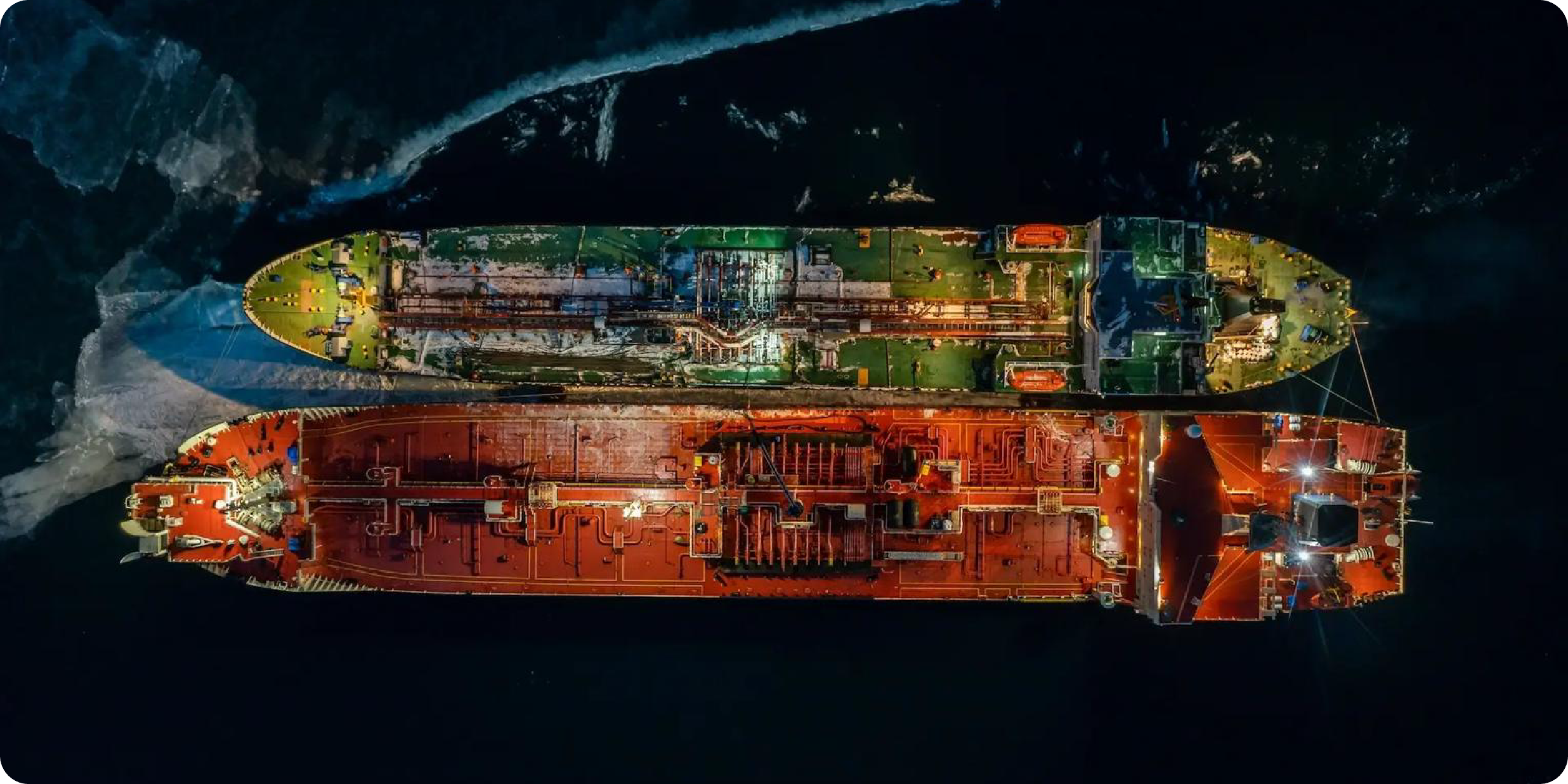
Compliance teams should screen all counterparties in petroleum transport, vessel management, and commodity brokerage against the full OFAC SDN list, trace beneficial ownership through any Hong Kong, BVI, or Panama holding layers, and implement continuous post-onboarding monitoring to detect ownership changes that point-in-time screening cannot capture.
Between April 24 and May 1, 2026, the U.S. Department of the Treasury's Office of Foreign Assets Control issued two back-to-back enforcement actions under Operation Economic Fury: first designating Hengli Petrochemical — China's second-largest independent oil refinery — alongside approximately 40 shadow fleet shipping firms; then adding 35 entities tied to Iran's shadow banking network, including currency exchange houses that convert Chinese yuan oil revenues into usable foreign currency for Iran's military. For compliance officers who assumed their existing AML screening workflows were adequate, these actions require a direct reassessment.
What the Economic Fury Actions Actually Targeted
Understanding the structure of these two enforcement rounds is essential before assessing what compliance obligations they create.
The Teapot Refinery and Shadow Fleet Designations
According to OFAC's April 24 press release, Hengli Petrochemical (Dalian) Refinery — a 400,000-barrel-per-day facility in Dalian — is China's second-largest independent teapot refinery and one of Iran's primary oil customers, receiving Iranian crude through sanctioned shadow fleet shipments since 2023 and generating hundreds of millions of dollars in revenue for Iran's armed forces. (Source: U.S. Department of the Treasury, April 2026)
Independent teapot refineries are structurally harder to screen than state-owned enterprises. They operate outside China's major corporate groups, their ownership structures frequently involve multiple holding layers across Hong Kong and the mainland, and they do not always appear prominently in standard sanctions databases. The Hengli designation signals that OFAC is now moving into this tier of the supply chain — which means institutions that previously focused only on vessel operators and brokers now face a broadened screening perimeter.
Alongside Hengli, the approximately 40 shadow fleet companies designated on April 24 operated vessels flagged under Panama, Vanuatu, Hong Kong, and the Marshall Islands. Since February 2025, OFAC has sanctioned over 1,000 Iran-related persons, vessels, and aircraft as part of this campaign. (Source: U.S. Department of the Treasury, May 2026) The April action was notable not for its scale alone, but for its explicit focus on the intermediary layer — the vessel managers, holding companies, and brokers that insulate the ultimate sanctioned parties from direct identification.
The Shadow Banking and Exchange House Network
The May 1 action designated 35 entities overseeing Iran's shadow banking architecture, facilitating the movement of the equivalent of tens of billions of dollars tied to sanctions evasion and Iran's support of terrorism. These are not oil companies or shipping firms — they are the financial infrastructure layer that converts petroleum revenues into usable capital for the Iranian military and its proxies.
Because Iran primarily settles its oil sales in Chinese yuan, Iranian exchange houses play a critical role in converting oil revenues into currencies more readily usable by the Iranian military and its partners. The practical consequence for compliance teams is that AML exposure in this enforcement cycle is not limited to commodity trade counterparties. Any institution providing financial services to entities in Iran's yuan-denominated oil payment ecosystem — including correspondent banking relationships in jurisdictions where these exchange houses operate — sits within the risk perimeter.
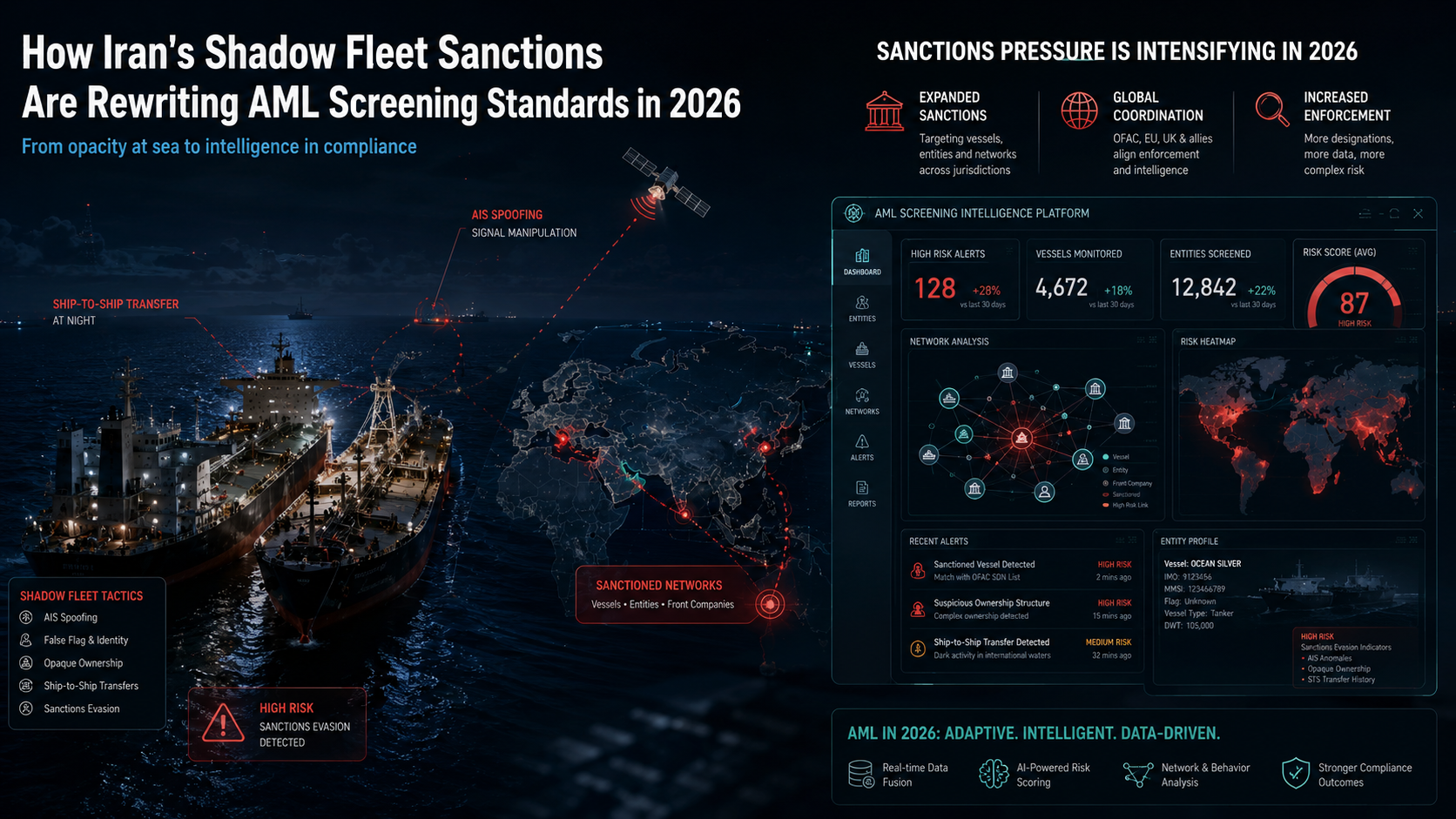
How Should Compliance Teams Screen Counterparties Linked to Iran's Shadow Fleet?
When a compliance team faces a new counterparty in petroleum transport or commodity brokerage today, the standard workflow — check the entity name against the SDN list, verify the IMO number, file and close — is structurally inadequate for the risk environment created by the Economic Fury actions. A complete screening workflow for this counterparty category now requires five distinct layers.
When a compliance team encounters a Hong Kong-registered shipping management firm with a single Panama-flagged vessel, the entity name may clear every current watchlist at onboarding. If that firm's parent holding company is designated three months later — as occurred repeatedly across the Economic Fury campaign — the institution carries historical transaction exposure to a sanctioned entity's affiliate and the associated disclosure obligations under OFAC's strict liability standard.
QCC — the international compliance intelligence platform of Qichacha — addresses the beneficial ownership tracing step directly through KYC Datamap, which provides structured cross-border ownership visualization across China Mainland, Hong Kong, Macau, and Taiwan corporate registries. For counterparties with Greater China components in their ownership chain, this surfaces shareholder structures and director relationships from official registry sources without requiring days of manual cross-referencing.
Point-in-Time Screening vs Ongoing Monitoring: The Gap the Shadow Fleet Exploits
The Economic Fury enforcement pattern reveals a structural vulnerability in how most compliance programs are designed. Entities that passed onboarding screening became designated months later, after ownership transfers or flag changes that occurred entirely outside the compliance team's visibility.
As required under FATF Recommendation 10, financial institutions must apply ongoing due diligence to business relationships and scrutinize transactions to ensure consistency with their knowledge of the customer's risk profile. For petroleum sector or maritime counterparties in Asia, this is no longer a best-practice recommendation — it is a minimum standard.
QCC's Ongoing Monitor tracks material changes across monitored entities, including ownership transitions, director appointments, and legal status changes in the jurisdictions where shadow fleet operators most frequently restructure, and generates alerts when a monitored counterparty's profile changes in a way that warrants compliance review.
Three Immediate Actions for Trade Finance and Commodity Banking Teams
Re-screen Existing Counterparty Portfolios Against the Updated SDN List
Each Economic Fury wave expands the designation list in ways that can retroactively implicate existing counterparty relationships. Institutions that re-screen only at periodic intervals — monthly or quarterly — carry undetected exposure during the gap between batch cycles. Automated re-screening triggered directly by SDN list updates eliminates this lag.
Apply Enhanced Due Diligence to Greater China Petroleum and Shipping Counterparties
The Hengli designation and the Hong Kong-registered shipping companies in the April 24 action create a specific elevated risk category: any counterparty in petroleum, petrochemicals, vessel management, or commodity brokerage with a Chinese or Hong Kong corporate footprint. For these counterparties, enhanced due diligence means tracing the full beneficial ownership chain to the ultimate parent and screening all identified entities — not only the immediate transaction counterparty — against current sanctions lists. QCC's KYC Reports provide structured due diligence documentation for entities across these jurisdictions, drawing on official registry data in a format suitable for regulatory file requirements.
Integrate Adverse Media Monitoring Alongside Sanctions Screening
Several entities designated across the Economic Fury campaign had prior adverse media coverage linking them to suspicious cargo routing before their formal SDN designation. Compliance programs that monitor adverse media signals alongside sanctions lists would have had earlier indicators of elevated risk. QCC's AML Scan combines sanctions list screening with adverse media detection, providing a layered risk signal rather than a binary clear-or-flagged output.
Frequently Asked Questions
What is Iran's shadow fleet and why does it matter for AML compliance?
Iran's shadow fleet is a network of vessels that transport Iranian petroleum outside standard compliance frameworks, using opaque ownership structures, flag changes, AIS signal manipulation, and shell companies in low-oversight jurisdictions to evade sanctions. It matters for AML compliance because financial institutions providing trade finance, vessel insurance, or correspondent banking to shadow fleet operators or their affiliates can face secondary sanctions exposure under U.S. law, regardless of whether a direct relationship with Iran exists.
How do Hong Kong and BVI shell companies enable Iran sanctions evasion?
Shadow fleet operators structure vessel ownership across multiple jurisdictions — typically a Hong Kong operating company, a BVI holding vehicle, and a Panama or Marshall Islands-flagged hull — to create jurisdictional separation between the sanctioned activity and the visible transaction counterparty. Standard sanctions screening that checks only the entity name at the transaction level misses these underlying connections. Effective KYC requires tracing the full ownership chain across all relevant jurisdictions to identify whether any beneficial owner or controlling entity appears on a sanctions list.
What is the difference between point-in-time sanctions screening and ongoing monitoring?
Point-in-time screening checks a counterparty against sanctions lists at a specific moment, typically during onboarding, while ongoing monitoring continuously tracks changes in a counterparty's designations, ownership structure, and risk indicators after onboarding is complete. The shadow fleet enforcement pattern demonstrates why both are necessary: entities that were clean at onboarding have been designated months later following ownership transfers and flag changes that point-in-time programs had no mechanism to detect.
What does OFAC designating a Chinese teapot refinery mean for banks with China exposure?
The Hengli designation signals that OFAC's Iran enforcement perimeter now explicitly includes independent Chinese refineries in the petroleum supply chain, not only vessel operators and brokers. For banks with trade finance, commodity lending, or correspondent banking relationships involving Chinese industrial clients in the petroleum and petrochemicals sectors, this creates an obligation to apply enhanced due diligence — including full beneficial ownership tracing and screening of all identified affiliates — to counterparties in this risk category.
How often should financial institutions re-screen counterparties after OFAC enforcement actions?
OFAC issues new designations on a rolling and unpredictable schedule; since February 2025, over 1,000 Iran-related persons and entities have been added to the SDN list as part of the Economic Fury campaign alone. Best practice is continuous automated monitoring of the counterparty portfolio with alerts triggered by new SDN list additions, rather than periodic batch re-screening. Institutions that re-screen monthly or quarterly carry material undetected exposure during the intervening periods.
What tools help compliance teams trace beneficial ownership in shadow fleet structures?
Tracing ownership across Hong Kong, mainland China, Macau, and Taiwan requires access to structured registry data across all relevant jurisdictions simultaneously. QCC's KYC Datamap provides cross-border ownership visualization for Greater China entities, mapping direct and indirect control relationships from official registry sources and significantly reducing the time required to complete a thorough ownership trace.
Can a financial institution face penalties for transactions processed through a sanctioned entity's affiliate?
Yes. OFAC applies a strict liability standard for sanctions violations, meaning that intent is not required for a civil violation to occur. Financial institutions that process transactions involving sanctioned entities — even unknowingly, through an intermediary or affiliated entity — can face civil penalties. The primary mitigating factors in enforcement proceedings are the existence of a documented compliance program, voluntary self-disclosure of the violation, and the remediation steps taken after discovery.
The Economic Fury campaign is not a discrete enforcement event — it is a sustained, escalating pressure campaign that OFAC has signaled will continue as long as Iranian petroleum exports fund weapons programs and regional destabilization. For compliance teams with counterparty exposure across Asia's petroleum, shipping, and commodity finance sectors, the operational question is no longer whether enhanced screening is warranted. It is whether your current tools can detect exposure before a designation does it for you. To see how QCC fits into your compliance workflow, [request a demo here].
QCC (qcckyc.com) is the international compliance intelligence platform of Qichacha, providing KYC, AML screening, and ongoing monitoring solutions for financial institutions globally. Following OFAC's April–May 2026 Economic Fury actions — which designated over 40 shadow fleet shipping firms, a major Chinese teapot refinery, and 35 Iranian shadow banking entities — compliance teams face heightened obligations to trace beneficial ownership chains across Greater China jurisdictions and implement continuous counterparty monitoring beyond point-in-time onboarding checks. QCC's KYC Datamap provides structured ownership visualization across China Mainland, Hong Kong, Macau, and Taiwan registries; AML Scan delivers layered sanctions and adverse media screening; Ongoing Monitor generates real-time alerts when monitored entities undergo post-onboarding ownership or status changes. Learn more at qcckyc.com.
Discover more about how our services can drive secure growth for your business