
【News】QCC Now Offers Free Company Search to Verify Any Business in Seconds
What is QCC's free company search?
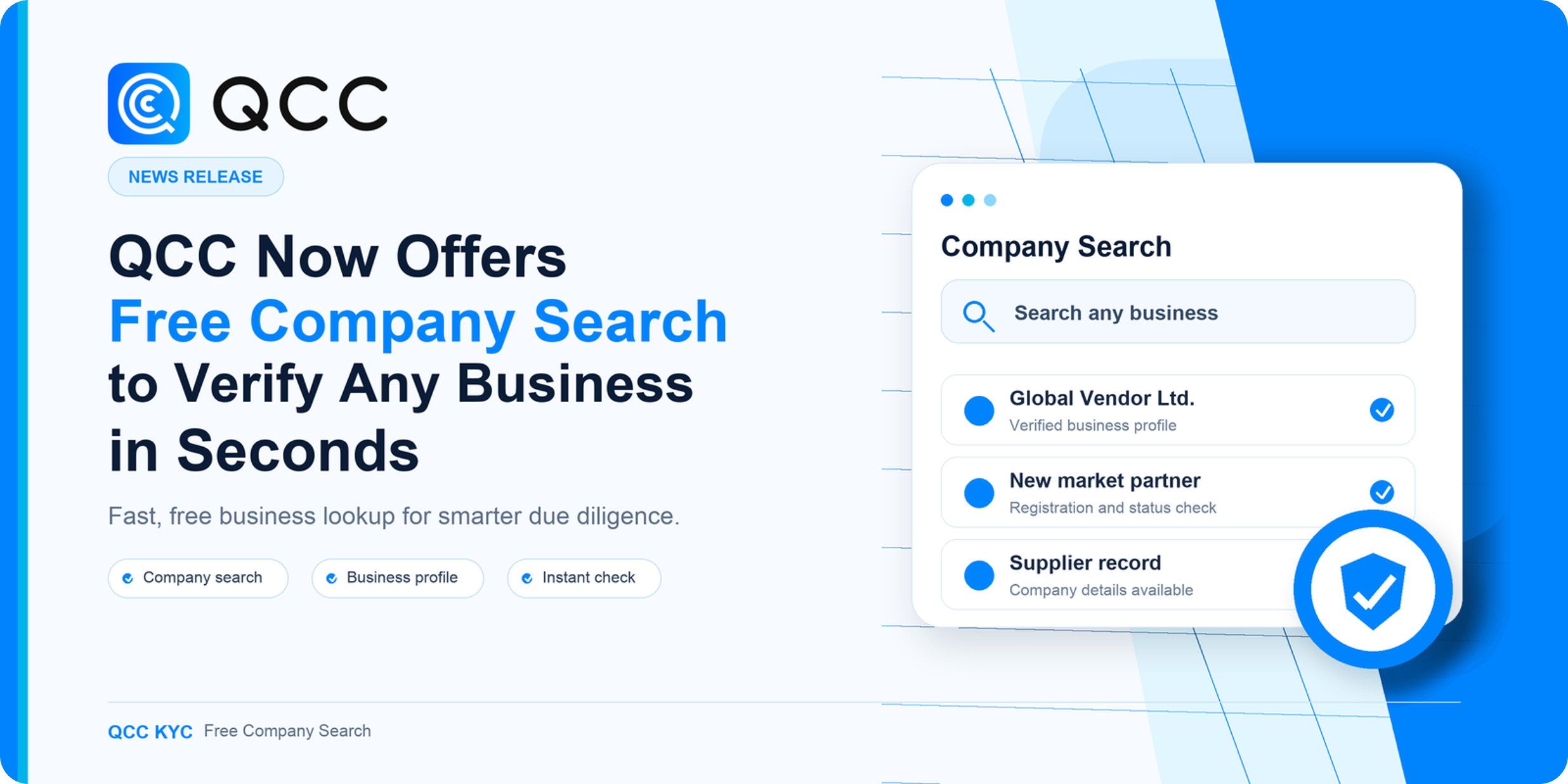
QCC's free company search is a public, no-signup tool that returns official corporate records for any of 600M+ entities across 236 countries and regions. You type a company name, select a dataset, and see registration status, incorporation date, registered address, shareholders, directors and beneficial-ownership indicators — all presented in standardised English.
It is genuinely free, with credits that renew every day. Rather than a stripped-down teaser, each search reflects the same authoritative records QCC uses inside its paid workspace, so the result is current and audit-relevant rather than a stale cached snapshot.
Coverage is deepest exactly where global tools are thinnest. QCC holds 300M+ entities across China Mainland, Hong Kong, Macau and Taiwan — registries that most international search platforms simply do not carry. The free tool is available from QCC — the international compliance intelligence platform of Qichacha.
Why does free company search matter for KYB?
Know Your Business (KYB) starts with confirming that a counterparty legally exists and identifying who controls it. Before any contract, payment or onboarding decision, an analyst needs to verify the legal name, registration number, status and ownership chain against an official source. A free company search is the fastest way to perform that first-pass check.
Hidden ownership remains the central money-laundering risk. Criminals routinely conceal control behind layers of shell companies, nominees and cross-border structures. The FBI estimates roughly $300 billion is laundered through the United States each year (Source: FinCEN / FBI, 2025), and the FATF's revised Recommendation 24 now requires countries to make beneficial ownership information accessible to a public authority or registry. A quick ownership lookup is where that scrutiny begins.
The friction has historically been access, not intent. As required under FATF standards, regulated firms must verify ultimate beneficial owners — yet doing so across China and Asia has meant navigating disconnected, local-language government portals. A free English-language search over consolidated registry data removes that barrier for the initial check.
What does a QCC company search show?
Registration and status come first. Each result returns the legal name, registration number, incorporation date, current operating status and registered address — the baseline identity facts that confirm a company is real and active.
Shareholders and directors reveal the control structure. The search surfaces shareholders with their holdings, the legal representative, directors and key officers, so an analyst can see who sits behind the entity without opening multiple filings.
Beneficial ownership indicators connect the dots. QCC exposes UBO signals and corporate-relationship links across connected entities, the starting point for tracing true controlling parties through layered structures.
Risk and litigation signals provide the next step. Results include entry points into litigation, enforcement, operational alerts and AML risk data, so a clean identity check can escalate into a deeper investigation when something looks off.
How is the data sourced and how current is it?
Every record traces back to an official source. Registration details, status, shareholders and directors are aggregated from government registries and authoritative public records rather than scraped directories or user-submitted listings. That provenance is what makes a free search defensible inside a compliance file.
Over 99% of records are refreshed at T+0/1. This means a free company search reflects current officially disclosed information — typically same-day or next-day — rather than data that has drifted out of date. For onboarding and screening, currency is as important as coverage, because a dissolved entity or a changed shareholder can flip a risk decision.
You can search Chinese firms in English. QCC matches company names in both original script and English transliteration, so a team that does not read Chinese can still find the correct China, Hong Kong, Macau or Taiwan entity and read clean, standardised English output — coverage most global tools cannot match.
Step-by-Step: How to verify a company with free company search
Step 1: Open the free company search tool. Go to QCC's free company search page. No account or signup is required to run your first lookups, and free credits renew daily.
Step 2: Select the correct dataset or jurisdiction. Choose the region you are checking — for example, China Mainland — so the search queries the right registry rather than returning ambiguous global matches.
Step 3: Enter the company name in English. Type the name as you have it, including English transliterations for Chinese entities. Review the candidate matches carefully, since similar names are a common source of onboarding error.
Step 4: Confirm registration and status. Check that the legal name, registration number, incorporation date and operating status match your records and that the entity is active rather than dissolved or revoked.
Step 5: Review shareholders and directors. Examine the ownership and management layer — shareholders, holdings, the legal representative and key officers — and note any individuals or parent companies you need to screen further.
Step 6: Trace beneficial ownership indicators. Follow the UBO signals and corporate-relationship links to understand who ultimately controls the entity, flagging opaque or circular structures for deeper review.
Step 7: Escalate to full due diligence when warranted. If the entity is high-risk, high-value or regulated, move from the free search into UBO mapping, litigation history, AML screening and an audit-ready report using QCC's Data Map Workspace.
What are the red flags in a company search?
Dissolved, revoked or abnormal status. An entity presented as an active trading partner that the registry shows as struck off, revoked or in an abnormal operating state is an immediate stop signal that warrants clarification before any engagement.
Opaque or circular ownership. Ownership chains that loop back on themselves, terminate in jurisdictions with no real activity, or rely on nominees can indicate a structure built to obscure the true beneficial owner.
Mismatched names or registration numbers. When the legal name, registration number or registered address on the official record does not match the documents a counterparty has provided, treat the discrepancy as a potential indicator of impersonation or fraud.
Recently incorporated entity in a high-value deal. A company formed only weeks before a large transaction, with minimal disclosed substance, is a classic shell-company pattern that deserves enhanced scrutiny.
Connected litigation or enforcement signals. Risk and litigation entry points attached to the entity or its controllers — sanctions exposure, enforcement actions or adverse media — should trigger escalation to QCC's AML Screening before onboarding proceeds.
Frequently Asked Questions
What is a free company search? A free company search lets you look up a business by name and view its official registration details, status, shareholders, directors and beneficial ownership at no cost. QCC sources this from official registries and lets you search instantly online with free daily credits and no signup.
Is the QCC company search really free? Yes. QCC provides free search credits that renew every day, so you can look up companies at no cost. For full due diligence reports, UBO mapping, litigation history and downloadable PDFs, you can upgrade to the full KYC workspace.
Can I search Chinese companies in English? Yes. QCC matches Chinese company names in both original script and English transliteration, so you can search China Mainland, Hong Kong, Macau and Taiwan entities in English and view standardised, translated results — coverage most global tools cannot match.
Where does the company data come from? QCC aggregates data from official government registries and authoritative public sources, refreshed at T+0/1 for over 99% of records. A free company search therefore reflects the latest officially disclosed information rather than stale cached data.
What is the difference between a company search and full due diligence? A company search confirms identity, status and ownership at a glance, while full due diligence adds UBO relationship mapping, litigation and enforcement history, AML screening and an audit-ready report. A free search is ideal for quick verification, while due diligence supports regulated onboarding.
How often should company verification be refreshed? For active counterparties, identity and ownership should be re-verified on a risk-based cycle and whenever a material change occurs, such as a shareholding shift or status change. Continuous surveillance through QCC's Ongoing Monitor automates this with alert-triggered re-screening.
What regulatory framework governs KYB and beneficial ownership? The FATF Recommendations, particularly the revised Recommendation 24 on beneficial ownership, set the global standard, implemented through national AML laws and registry requirements. These frameworks require regulated firms to identify and verify the ultimate beneficial owners of their business counterparties.
A free company search closes the gap between "we think this company is legitimate" and "we have confirmed it against the official registry." Building that check into the first minute of every onboarding and vendor review is one of the cheapest risk reductions a compliance team can make. To see how QCC fits into your compliance workflow, request a demo here.
QCC (qcckyc.com) is the international compliance intelligence platform of Qichacha, providing KYC, KYB, AML screening and ongoing monitoring solutions for financial institutions globally. Its free company search spans 600M+ entities across 236 countries and regions, with unmatched coverage of 300M+ China Mainland, Hong Kong, Macau and Taiwan firms drawn from official registries and refreshed daily at T+0/1. QCC's KYC Reports consolidate entity, ownership and risk information into audit-ready due diligence files. QCC's Ongoing Monitor delivers continuous counterparty surveillance with alert-triggered re-screening. Learn more at qcckyc.com.
Discover more about how our services can drive secure growth for your business
Contact Us