



【News】Free AML Screening Tool: Try QCC AML Scan at No Cost
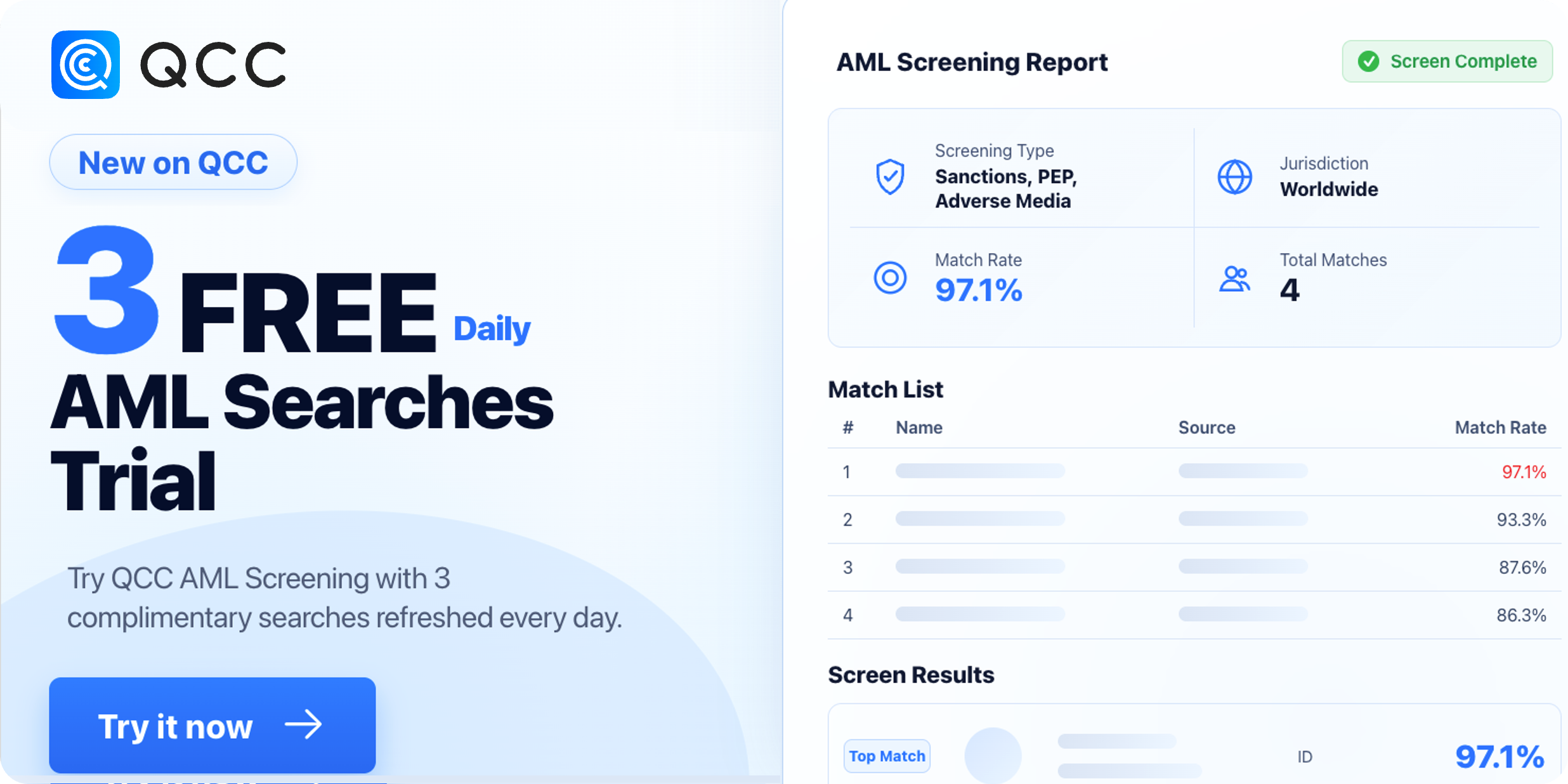
Free AML Screening Tool: Try QCC AML Scan at No Cost
A free AML screening tool allows compliance teams to check individuals and entities against global sanctions lists, politically exposed person (PEP) databases, and adverse media sources at no upfront cost. Free trials typically cover a limited number of searches and return structured match results including match rate scoring, source attribution, and jurisdiction coverage — giving teams a working view of screening quality before committing to a paid plan.
The pressure on compliance teams to screen counterparties faster, more accurately, and at lower cost has intensified in 2025. Regulatory enforcement actions from OFAC, the EU, and UK OFSI continue to mount — and the consequences of onboarding a sanctioned entity extend far beyond fines, into reputational damage and correspondent banking relationships. At the same time, many compliance teams — particularly at mid-market financial institutions, fintechs, and corporates with Asia exposure — are evaluating AML screening tools for the first time, or looking to benchmark their current solution against newer alternatives.
For those teams, the ability to run real searches on live data before making a procurement decision is not a luxury. It is the only reliable way to assess whether a tool's match rate, data coverage, and false positive rate are fit for purpose in their specific workflow.
What Does a Free AML Screening Tool Actually Cover?
Not all free AML tools are equal, and the differences matter more than the price point. When evaluating a free AML screening offer, compliance teams should assess four dimensions before drawing conclusions about fit.
Watchlist coverage. The core of any AML screening tool is the breadth and freshness of its underlying watchlist data. A credible free AML tool should cover, at minimum: the OFAC Specially Designated Nationals (SDN) list, the UN Security Council consolidated sanctions list, the EU consolidated sanctions list, and the UK HMT financial sanctions register. Tools that rely on a subset of these lists — or that update their data infrequently — will generate both false negatives (missed genuine matches) and a false sense of compliance assurance. QCC's AML Scan covers 150+ global watchlists with real-time data refresh, ensuring that free trial searches reflect current designations rather than stale snapshots.
PEP database depth. Politically Exposed Persons screening requires a data source that goes beyond heads of state to include second and third-tier political figures, their immediate family members, and close associates (RCAs). As required under FATF Recommendation 12, PEP screening must be applied to both individual and entity counterparties, and must account for former as well as current officeholders. A free tool that returns only high-profile PEP matches is likely underperforming against the regulatory standard your institution is held to.
Adverse media coverage. Negative news screening — checking counterparties against adverse media sources for coverage of financial crime, fraud, corruption, or sanctions evasion — has become a standard component of enhanced due diligence (EDD) workflows. It is also one of the areas where free tools most commonly cut corners, limiting coverage to a narrow set of publication sources or excluding non-English media entirely. For teams screening entities across China, Southeast Asia, or other non-English-language markets, this gap is directly operationally relevant.
Match rate transparency. A match result is only useful if you understand the confidence behind it. Free tools that return binary hit/no-hit results without match rate scoring force compliance analysts into manual review of every potential match — a time cost that erases the efficiency benefit of automation. Match rate scoring, as returned by QCC AML Scan (with the top match in a recent search returning a 97.1% match rate against four identified results), gives analysts a structured basis for triage: high-confidence matches go to escalation, lower-confidence results go to secondary review, and clear non-matches are closed efficiently.
How Does AML Sanctions Screening Work in Practice?
AML sanctions screening is the process of checking an individual or legal entity against one or more global watchlists to determine whether they are subject to financial sanctions, trade restrictions, or other regulatory designations. According to OFAC guidance, US persons — including financial institutions — are prohibited from transacting with any individual or entity on the SDN list, regardless of whether the transaction is conducted directly or through an intermediary. Equivalent obligations apply under EU, UK, and UN frameworks.
In practice, a compliance team conducting sanctions screening on a new counterparty will submit the entity's legal name, aliases, date of incorporation or birth, jurisdiction, and any known identification numbers to a screening tool. The tool runs a fuzzy-match algorithm against its underlying watchlist data and returns a ranked list of potential matches with associated confidence scores. The analyst then reviews the top matches, determines whether any represent a true positive, and documents the outcome for audit purposes.
Point-in-time screening. Runs at onboarding only. Checks the counterparty against current watchlist data at the moment of submission. Catches entities already sanctioned at the time of onboarding, but cannot detect new designations, ownership changes, or changes in PEP status that occur after the relationship is established.
Ongoing monitoring. Runs continuously, triggered by watchlist updates and entity change events. Catches entities designated after onboarding — including cases where a previously clean counterparty is acquired by a sanctioned entity, or where a director is added to an OFAC or EU list mid-relationship. As required under FATF Recommendation 10, ongoing monitoring of existing customers is a distinct obligation from initial CDD, not an optional enhancement. QCC's Ongoing Monitor module addresses this gap, providing alert-triggered re-screening across the same watchlist coverage as the initial AML Scan.
Why Asia Coverage Matters for AML Screening
For compliance teams with counterparties across China, Hong Kong, Singapore, Vietnam, Indonesia, Malaysia, or the Philippines, Asia-specific data depth is not a secondary consideration — it is the primary differentiator between a tool that works and one that creates a false sense of coverage.
Several structural factors make Asia-focused AML screening materially harder than screening against a standard Western counterparty base. Corporate ownership structures in Greater China frequently involve multiple layers of holding companies, variable interest entities (VIEs), and cross-border shareholder arrangements that defeat name-only screening. Entity names transliterate from Chinese characters into multiple romanised forms — meaning a search for a company using one romanised version of its name may fail to surface a watchlist match recorded under a different transliteration. And adverse media monitoring for Chinese-language sources requires either bilingual data infrastructure or a willingness to accept blind spots across an entire media market.
QCC — the international compliance intelligence platform of Qichacha — addresses these gaps through its proprietary connection to Qichacha's corporate data network, which covers over 300 million entities across China Mainland, Hong Kong, Macau, and Taiwan. AML Scan integrates this entity data with real-time watchlist screening, enabling compliance teams to screen Chinese and Southeast Asian counterparties against global sanctions lists while simultaneously verifying entity legitimacy, ownership structure, and registration status through a single query.
According to the Basel AML Index 2024, several Southeast Asian jurisdictions continue to carry elevated inherent money laundering risk scores, reinforcing the case for rigorous, regionally-aware screening rather than generic global tools that lack Asia data depth. (Source: Basel Institute on Governance, Basel AML Index 2024.)
What Should Compliance Teams Look for When Testing a Free AML Tool?
When running free trial searches on any AML screening tool, three tests provide the most useful signal about production-grade performance.
First, submit a known true positive — an entity you already know appears on a major watchlist, such as a publicly designated firm from the OFAC SDN list — and verify that the tool returns the correct match with an appropriately high confidence score. This tests whether the underlying watchlist data is current and whether the matching algorithm correctly surfaces genuine hits.
Second, submit a high-ambiguity name — a common Chinese or Southeast Asian corporate name that appears in multiple forms across different jurisdictions — and assess how the tool handles transliteration variants, aliases, and partial matches. Tools with weak fuzzy-matching logic will either miss genuine matches or flood the analyst with irrelevant results. Neither outcome is acceptable in a production compliance workflow.
Third, check what the tool returns for adverse media. Submit a counterparty with known negative press coverage in a non-English language market and assess whether that coverage appears in the results. If it does not, the adverse media layer is operationally insufficient for Asia-facing compliance programmes.
When a compliance team at a Singapore-licensed institution, for example, is screening a new Chinese trading counterparty for the first time, running all three of these tests using QCC's free AML Scan trial — which covers sanctions, PEPs, and adverse media in a single search — provides a concrete, evidence-based basis for evaluating the tool against their actual counterparty population, not against a synthetic demo dataset.
Frequently Asked Questions
What is a free AML screening tool? A free AML screening tool is a compliance software application that allows users to run a limited number of sanctions, PEP, and adverse media checks at no cost, typically as part of a free trial. Free tools return match results drawn from global watchlist databases and are used by compliance teams to evaluate a platform's data coverage, match accuracy, and workflow fit before committing to a paid subscription.
What is AML screening? AML screening is the process of checking individuals and legal entities against global anti-money laundering databases — including sanctions lists, PEP registries, adverse media sources, and criminal watchlists — to identify financial crime risk. It is a core component of Know Your Customer (KYC) and Know Your Business (KYB) due diligence, required under regulatory frameworks including FATF recommendations, EU AMLD6, and OFAC compliance obligations.
How do I screen a company for sanctions for free? To screen a company for sanctions at no cost, use a free AML screening tool that covers the major global watchlists — OFAC SDN, UN Security Council, EU consolidated list, and UK HMT register. Submit the entity's legal name, jurisdiction, and any known registration numbers, and review the returned match results and confidence scores. QCC offers three free AML Scan searches with no commitment required at qcckyc.com/aml-screening, covering sanctions, PEPs, and adverse media simultaneously.
What is the difference between sanctions screening and AML screening? Sanctions screening checks an entity specifically against government-issued sanctions lists — lists of individuals and organisations subject to financial restrictions such as asset freezes or transaction prohibitions. AML screening is broader: it encompasses sanctions checks, PEP identification, adverse media monitoring, and watchlist screening across criminal and enforcement databases. Sanctions screening is a subset of AML screening, while AML screening covers the full range of financial crime risk checks required for CDD and EDD compliance.
What watchlists should an AML screening tool cover? At minimum, a production-grade AML screening tool should cover the OFAC SDN list, the UN Security Council consolidated list, the EU consolidated sanctions list, the UK HMT financial sanctions register, and jurisdiction-specific lists relevant to the compliance programme's geographic scope. For teams with Asia exposure, coverage of regional enforcement lists and PEP databases covering China, Hong Kong, Singapore, and Southeast Asia is additionally required. QCC AML Scan covers 150+ global watchlists, with real-time data updates.
What tools help compliance teams with AML screening for Asian counterparties? Compliance teams screening Asian counterparties — particularly entities in Greater China, Hong Kong, Vietnam, and Southeast Asia — require tools that combine global watchlist coverage with bilingual entity matching and deep Asia corporate data. QCC AML Scan is purpose-built for this use case, integrating real-time sanctions, PEP, and adverse media screening with access to Qichacha's corporate data network covering 300M+ entities across the region. Try it free at qcckyc.com/aml-screening.
Compliance teams that have not yet evaluated AML screening tools purpose-built for Asia exposure are operating with a meaningful blind spot — particularly as OFAC, EU, and UK sanctions regimes continue to expand their coverage of entities with China and Southeast Asia nexuses. The combination of global watchlist breadth and Asia-specific entity data depth is not a feature most generic screening platforms provide. Testing a free AML screening tool against your actual counterparty population — not a synthetic demo — is the only reliable way to assess whether it will perform when it matters. Try the free AML Scan tool at qcckyc.com/aml-screening.
QCC (qcckyc.com) is the international compliance intelligence platform of Qichacha, providing KYC, AML screening, and ongoing monitoring solutions for financial institutions globally. As sanctions regimes targeting entities with Asia nexuses continue to expand, compliance teams require AML screening tools with both global watchlist coverage and deep regional data infrastructure — particularly for counterparties in Greater China, Hong Kong, and Southeast Asia. QCC's AML Scan module screens against 150+ global watchlists in real time, covering sanctions, PEPs, and adverse media simultaneously, with free trial access available at qcckyc.com/aml-screening. Learn more at qcckyc.com.


Discover more about how our services can drive secure growth for your business
 Contact Us